In the life of a startup, some moments are riskier than others. The move from the incubator to the investment fund is one of them. A team has been supported for months: its file has grown, its milestones have been met, its mentors have left dozens of useful notes. Then comes the time to raise funds. And there, almost everything starts again from scratch.
The fund asks for the business plan again. It redoes its own market analysis. It raises questions the incubator had already answered six months earlier. The accumulated knowledge stays locked inside the previous organisation. The founder, for their part, re-enters, re-sends, re-explains.
A failed handoff has a cost: time lost, information degraded, and sometimes deals that run out of steam at the worst possible moment.
Why the handoff goes wrong
The problem is not human. Incubator and fund teams talk to each other, often know each other, and willingly share their impressions. The problem is one of tooling: there is no common space where a project can live for both the incubator and the fund at once.
Each organisation works in its own system — a spreadsheet, a CRM, an internal management tool. These systems do not communicate. So when a project “moves” from one to the other, it has to be recreated entirely on the other side.
Information gets lost. Mentoring notes, the history of decisions, the successive versions of the pitch: all of it stays inside the incubator. The fund rebuilds a partial picture, from whatever the founder is willing to send over again.
The founder does the liaison work. They become the transfer point. They resend the documents, redo the presentations, retransmit the figures. An administrative burden that lands precisely when they should be focusing on their raise.
Time works against the deal. The longer the transfer takes, the more the momentum fades. A project that was hot on leaving the incubator can turn lukewarm by the time the fund has rebuilt its file.
Co-tracking: one project, two organisations
The alternative is not to merge the incubator and the fund, nor to impose the same process on them. It is to let them work on the same project, each in its own way.
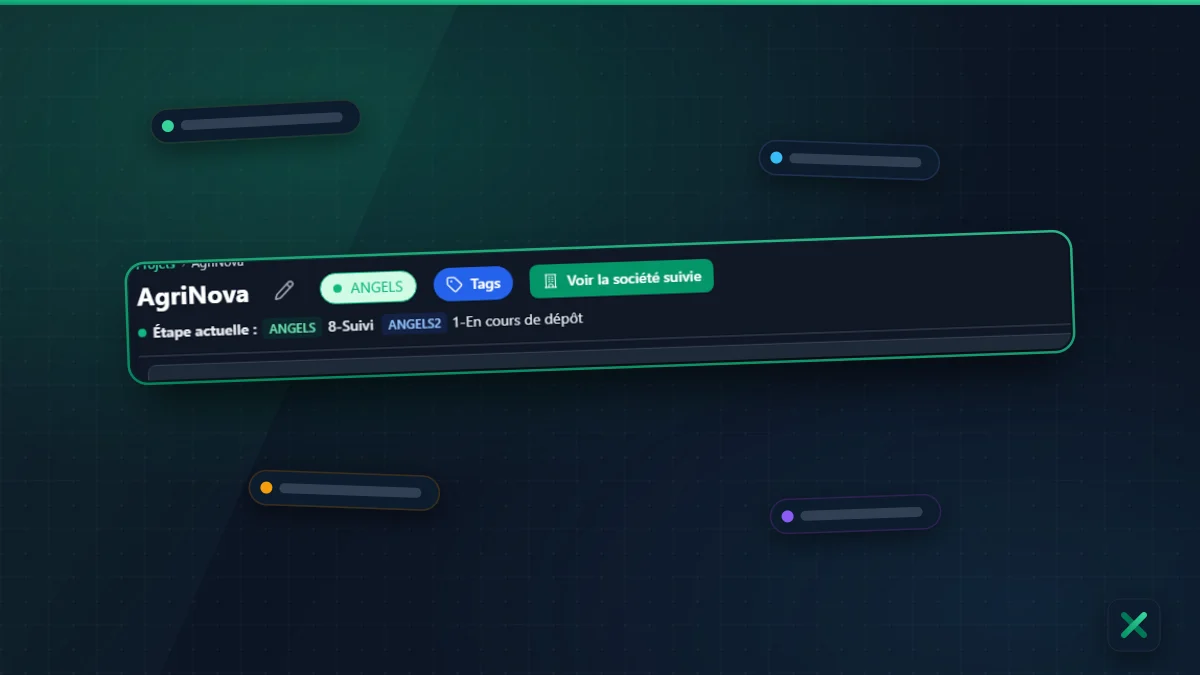
That is exactly what project sharing across organisations makes possible. The project exists only once. The incubator tracks it in its pipeline, with its coaching stages. The fund adds it to its own, with its due diligence stages. The founder only manages a single file.
The project isn’t recreated, it’s shared
When the incubator decides a startup is ready to raise, it exports nothing. It shares the project with the partner fund. In one click, the fund gets access to the file — within the limits of what has been consented.
The fund doesn’t start from a blank page. It discovers an already documented team, a coaching history, dated milestones. It saves weeks of review.
Each organisation keeps its own methods
Sharing imposes nothing. The incubator keeps its stages (“Selection”, “Coaching”, “Demo day”). The fund keeps its own (“Sourcing”, “Due diligence”, “Committee”, “Closing”). The same project moves forward simultaneously in both pipelines, at two different paces, without one disturbing the other.
Better still: each organisation configures its own view of the file. The incubator shows the tabs that matter to it; the fund switches on the required fields of its due diligence. The form adapts to each organisation, not the other way around.
Sharing stays under control
Handing over does not mean opening everything up. Sharing is granular and consented: you choose what you share — stages, documents, evaluations, messages — and reveal it case by case.
The incubator can share the presentation file and the milestones reached, but keep its mentors’ internal notes to itself. The founder, for their part, stays in control of what circulates about their project. Every access is logged.
What co-tracking changes in practice
Let’s replay the moment of the handoff, in its shared version.
The incubator has supported a startup for eight months. As the programme ends, it shares it with two early-stage funds from its network. Both funds immediately receive access to the consolidated file: team, market, traction, documents, history. Each adds it to its pipeline and starts its own review.
The founder resent nothing. They keep updating their file — a single one — and all three organisations see the latest version. When they add a new financial document, it appears everywhere. When a fund asks a question, it is logged on the project, not lost in an email thread.
The result: the handoff no longer breaks the momentum, it extends it. The fund builds on the incubator’s work instead of redoing it. And the founder stays focused on their raise.
Beyond the incubator and the fund
The incubator → fund handoff is the most telling example, but co-tracking holds true for the whole investment chain. Two funds co-investing in the same round. An investor club referring a project to a fund. A Business Angel network continuing the support after a first cheque. Wherever several organisations touch the same project, co-tracking replaces re-entry with sharing.
This is the continuity the investment ecosystem was waiting for: not one more tool to manage your own corner, but a common layer where projects move without getting lost.
Conclusion
The move of a startup from one organisation to another should not be a rupture. With the right tooling, it becomes a continuity: the project stays the same, the information follows, and each organisation adds its value without undoing the others’.
That is precisely what DealFlux was built for: letting different organisations share the same project, each one true to its own habits.
DealFlux is the platform for sharing projects across investment organisations. See how co-tracking works or book a demonstration.