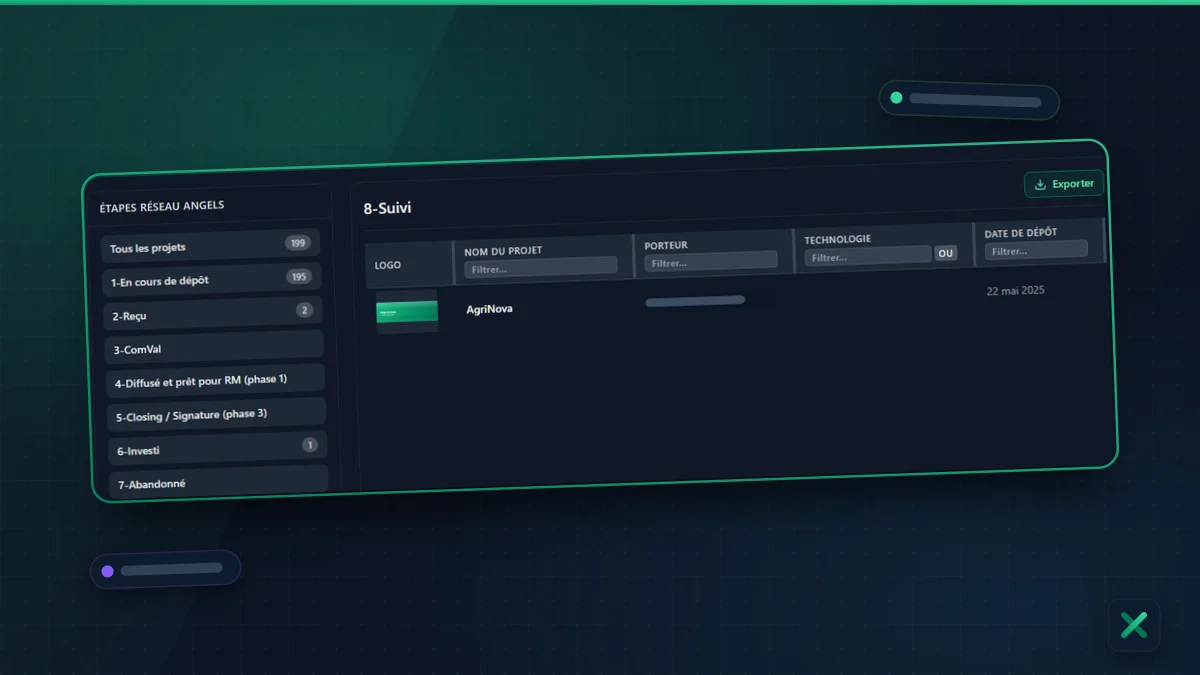
Running a Business Angel network is a permanent challenge. Between the flow of incoming deals, members to mobilise and collective decisions to orchestrate, management teams juggle a multitude of disconnected tools. Email, Excel spreadsheets, Dropbox, Notion, e-signature platforms: each step of the process relies on a different tool, and information fragments over time.
In 2026, the highest-performing networks have adopted a radically different approach: centralising the entire investment lifecycle on a single platform.
Why siloed management is counter-productive
The vast majority of Business Angel networks still operate in an artisanal way. A founder sends their deck by email. It is forwarded to a few trusted members. Feedback trickles back in disorder. A committee meets in person or by video. The decision is taken by a show of hands.
This way of working has several structural flaws.
Information loss is chronic. When a deal is sent by email, the history of exchanges is scattered across everyone’s inboxes. Two years later, it is impossible to retrieve the arguments that justified a rejection.
Evaluation is biased. When opinions are voiced in a meeting, the most charismatic members influence the others. A structured evaluation, conducted beforehand and in parallel, produces far better results.
Communication is time-consuming. Drafting an invitation email, chasing those who haven’t replied, sending a meeting summary: each communication cycle takes hours of the manager’s time.
The 5 pillars of professional management
1. A visual deal pipeline
The first priority is structuring the pipeline. Define your stages precisely: Application received → Shortlisting → Deep analysis → Network presentation → Committee → Decision → Closing.
Each stage must have clear criteria for moving forward. A deal enters “Deep analysis” once two members have validated the shortlist. It moves to “Network presentation” when the full file is available and validated.
This visual structure allows the entire management team to see at a glance where each deal stands, without sending follow-up emails.
2. Structured and complete files
Each deal must have a standardised file, accessible to all relevant members. This file includes:
- The executive summary: team, product, market, traction
- The financial documents: 3-year forecast, cap table
- The pitch deck and possibly a video presentation
- Exchanges and comments: everything that has been said about the deal
- The decision history: who voted what, and why
This file must be accessible to network members from any device, without having to dig through their inbox.
3. Structured collaborative evaluation
Evaluation is the core craft of a Business Angel network. It must be rigorous, repeatable and traceable.
Define your scoring grid: team, market, differentiation, traction, valuation. Assign weights to each criterion. Invite competent members (sector, stage) to evaluate the deal.
Scores are aggregated automatically. The manager has a synthetic view: average score, dispersion of opinions, key comments. The committee discussion is fuelled by this prior analysis rather than starting from scratch.
4. Automated communication
Communication takes time. As far as possible, it must be automated.
When a new deal enters “Network presentation”, an email is automatically sent to the available members. When a founder uploads an update, interested members are notified. When a committee is scheduled, invitations go out automatically with the right documents attached.
This automation frees the manager for higher-value work: supporting founders, animating the network, sourcing.
5. Statistics to steer the activity
A well-run network is a network that measures itself. How many deals have you received this quarter? What is the conversion rate between each stage? What is the average processing time? Which member is most active in evaluating?
These metrics make it possible to identify bottlenecks, recognise the most engaged members and report back to partners and funders.
Mistakes to avoid
Not keeping the pipeline up to date. A pipeline that isn’t maintained in real time quickly loses its value. Every stage change must be recorded immediately.
Not training members. Tool adoption is not automatic. Schedule a one-hour training session and appoint a “champion” within your network who masters the tool and can help peers.
Trying to digitise everything at once. Start with the pipeline and the deal files. Automated communication and statistics will come in a second phase.
A concrete example: the BA Île-de-France network
The BA Île-de-France network (anonymised) adopted this approach in 2024. Within six months, the number of deals processed per month doubled, going from 4 to 8. Average processing time fell from 45 to 22 days. Committee attendance rose from 60% to 85%.
How? By centralising every deal on DealFlux, by automating notification emails, and by rolling out a shared evaluation grid.
“The transformation took three months. The first results were visible within the second week,” reports the network’s manager.
Conclusion
Professionalising the management of a Business Angel network is not a question of technology, it is a question of method. Technology is only an accelerator. But without the right tool, even the best method runs into daily friction.
In 2026, networks that still manage their deals by email are falling behind. Founders notice the difference between a professional network and an artisanal one. And in a competitive market, that difference matters.
DealFlux is the management platform designed specifically for Business Angel networks, incubators and accelerators. Request a demo to see how it can fit your network.